🎓 レベル:標準 | 重要度:A(必須)
📎 前提:なぜサンプリングか | 数理:MCMC(マルコフ連鎖モンテカルロ)(統計・詳細釣り合いの証明)
要点(BLUF)
- メトロポリス・ヘイスティングス(MH)は、規格化されていない事後(尤度×事前)の値だけからサンプルを取る最も基本的な MCMC。受容確率に事後が比で入るので、解けない正規化定数 が約分で消えます。
- アルゴリズムは「提案 → 受容確率 で採否」。密度が下がる方向も比の確率で受け入れるから、山頂に貼り付かず分布全体を歩けます。
- 提案幅(step)が要調整:小さすぎると高受容だが動かず(相関大)、大きすぎると低受容。numpy 実装で を再現し、この調整を体験します。
1. アルゴリズム
現在地 から次の点を決める手順です(詳細釣り合い→定常分布の証明は MCMC(マルコフ連鎖モンテカルロ))。
- 提案:対称な提案分布から候補を出す。例:ランダムウォーク 。
- 受容確率:対称提案なら 。
- 採否: を引き、 なら受容して移動、そうでなければ棄却して現在地にとどまる(その点も標本に記録)。
は事後 ですが、受容確率では比なので
と が消えます。計算できる分子(尤度×事前)だけで回せる——これが なぜサンプリングか の壁を越える仕掛けです。
2. numpy でフル実装し、Beta(16,8) を再現する
正規化していない事後 ( 事前 × 二項 )を目標に、MH で標本を取り、真の事後 と一致するか見ます。対数で計算して桁あふれを防ぎます。
import numpy as np
from scipy import stats

# 目標:正規化なしの対数事後 log π(θ) = 15 log θ + 7 log(1-θ)  ([0,1] 外は -inf)
a0, b0, n, k = 2, 2, 20, 14
def log_target(t):
    if t <= 0 or t >= 1:
        return -np.inf
    return (a0 - 1 + k)*np.log(t) + (b0 - 1 + n - k)*np.log(1 - t)

def metropolis(step, N=40000, burn=2000, seed=0):
    rng = np.random.default_rng(seed)
    th = 0.5; lt = log_target(th)
    out = np.empty(N); acc = 0
    for i in range(N):
        cand = th + rng.normal(0, step)            # 対称ランダムウォーク提案
        lc = log_target(cand)
        if np.log(rng.uniform()) < lc - lt:        # u<exp(Δlog) ⇔ 受容
            th, lt = cand, lc; acc += 1
        out[i] = th                                # 棄却時は現在地を記録
    return out[burn:], acc/N

true = stats.beta(16, 8)
print(f"真の事後 Beta(16,8): 平均={true.mean():.4f}, 95%=[{true.interval(0.95)[0]:.3f}, {true.interval(0.95)[1]:.3f}]")
for step in [0.02, 0.1, 0.4]:
    s, ar = metropolis(step)
    lo, hi = np.quantile(s, [0.025, 0.975])
    print(f"  step={step:<4}: 受容率={ar:.2f}  標本平均={s.mean():.4f}  95%=[{lo:.3f}, {hi:.3f}]")
出力:
真の事後 Beta(16,8): 平均=0.6667, 95%=[0.471, 0.836]
  step=0.02: 受容率=0.93  標本平均=0.6699  95%=[0.463, 0.835]
  step=0.1 : 受容率=0.69  標本平均=0.6683  95%=[0.478, 0.837]
step=0.4 : 受容率=0.28 標本平均=0.6663 95%=[0.469, 0.836]出力の意味:どの step でも標本平均 ・95%区間 と、真の事後 を正しく再現しています。正規化定数を一度も計算せず、 の値だけでこれができたのが MH の威力です。一方で受容率は step とともに と下がります。次節でこの調整を見ます。
3. 提案幅のトレードオフと、トレースで見る歩き方
- step 小:候補が現在地のすぐ近く → ほぼ受容()。でも一歩が小さく、サンプルが互いに強く相関して分布を回りきるのが遅い。
- step 大:遠くへ跳ぶ → 多くが密度の低い所で棄却(受容率 )、同じ点に長くとどまる。
- 経験則として、1次元では受容率 〜 あたりが効率の良い目安(高次元では )。相関の強さは有効サンプルサイズで定量化します(収束診断)。
サンプルの時間変化(トレース)とヒストグラムを描くと、連鎖が事後を埋めていく様子が見えます。
import numpy as np
from scipy import stats
import matplotlib.pyplot as plt
import japanize_matplotlib  # 日本語ラベル用

a0, b0, n, k = 2, 2, 20, 14
def log_target(t):
    if t <= 0 or t >= 1: return -np.inf
    return (a0-1+k)*np.log(t) + (b0-1+n-k)*np.log(1-t)

rng = np.random.default_rng(0)
th, lt, step = 0.5, log_target(0.5), 0.4
chain = np.empty(40000)
for i in range(40000):
    cand = th + rng.normal(0, step); lc = log_target(cand)
    if np.log(rng.uniform()) < lc - lt: th, lt = cand, lc
    chain[i] = th
chain = chain[2000:]                                  # バーンイン除去

fig, ax = plt.subplots(1, 2, figsize=(11, 4))
ax[0].plot(chain[:1500], lw=0.6); ax[0].set_title("トレース(最初の1500ステップ)")
ax[0].set_xlabel("ステップ"); ax[0].set_ylabel("θ")
ax[1].hist(chain, bins=60, density=True, alpha=0.6, label="MH標本")
xx = np.linspace(0, 1, 300)
ax[1].plot(xx, stats.beta(16, 8).pdf(xx), lw=2, label="真の事後 Beta(16,8)")
ax[1].set_title("標本ヒストグラム vs 真の事後"); ax[1].set_xlabel("θ"); ax[1].legend()
plt.tight_layout(); plt.show()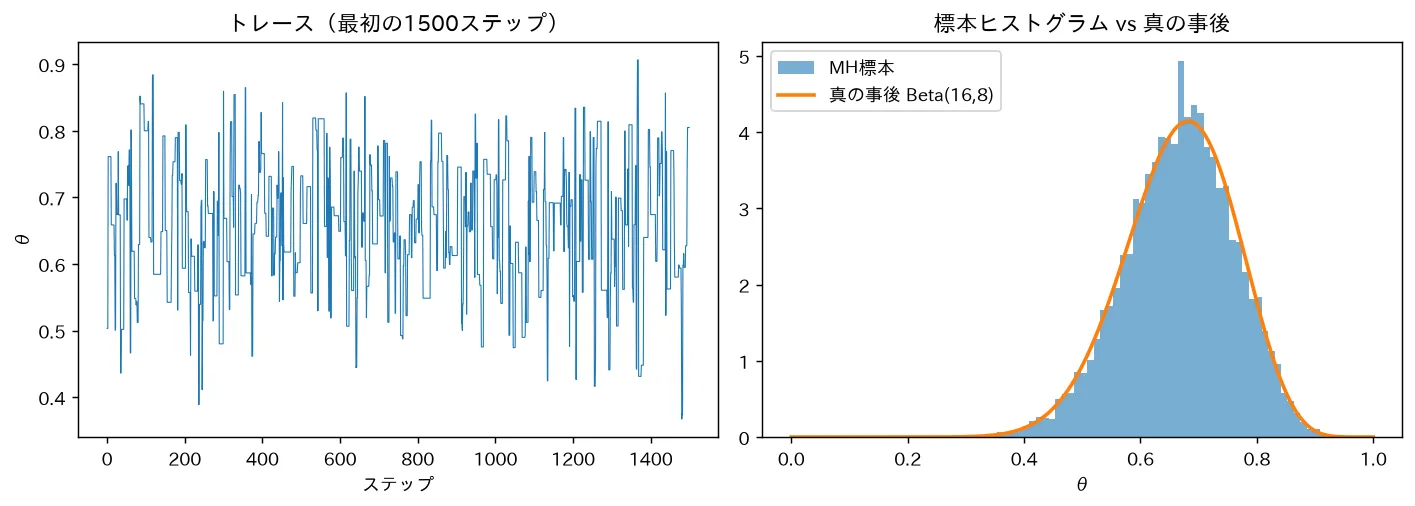
↑ トレース(最初の1500ステップ)
グラフの意味:左のトレースは水平な帯状にばらつき(定常に達したサイン)、上下に揺れながら事後の台 を往復します。右のヒストグラムは真の事後 (実線)にぴたりと重なります。トレースがドリフトしたり一点に張り付いたりせず帯状なら「収束していそう」と読めます(厳密な判定は 収束診断)。
⚠️ よくある誤解
- 「棄却したら記録しない」ではない:棄却時は現在地と同じ値を1標本として記録します。滞在時間が事後確率の高さを表すので、これを落とすと分布が歪みます(MCMC(マルコフ連鎖モンテカルロ))。
- 「受容率は高いほど良い」ではない:受容率 は step が小さすぎて動いていないサイン。高すぎず低すぎず(1次元で 〜)が目安。
- 「正規化定数が要る」ではない:受容確率は比なので は消えます。計算できない を回避できるのが MH の存在理由(§1)。
- 「1本の連鎖が帯状なら必ず収束」ではない:多峰分布では1本だと片方の山に閉じ込められることがあります。複数チェーンと で確認します(収束診断)。
関連ノート
- なぜサンプリングか
- ギブスサンプリング(次のトピック・条件付き分布で受容判定なし)
- 収束診断(受容率・相関・トレースの定量評価)
- MCMC(マルコフ連鎖モンテカルロ)(統計・受容確率が詳細釣り合いを満たす証明)
- 第4章 MCMC 目次
- ベイズ統計テキスト 全体目次